
At small scale, database management feels simple. You add a server, change a config file, run a migration, restart a service, and move on. At large scale, the same work becomes a different kind of problem. A small mistake can affect millions of users. A slow manual process can block releases. A single failed step in the middle of a cluster operation can waste hours of engineering time.
That is why Discord’s recent work around ScyllaDB is interesting for backend engineers, DevOps teams, and anyone building high-throughput database systems. Discord did not only scale its database. It rebuilt the way database operations were handled.
The main lesson is clear: automated database scaling is not just about adding more nodes. It is about creating safe, repeatable, recoverable workflows around the entire database lifecycle.
Discord’s engineering team shared how its Persistence Infrastructure team created an internal Scylla Control Plane, also called SCP, to automate large ScyllaDB operations across many clusters and hundreds of nodes. The team manages databases such as Elasticsearch, Postgres, and ScyllaDB, but ScyllaDB is especially important because it stores messages, channels, servers, and much of Discord’s user data.
For a platform like Discord, this is not a side system. It is core infrastructure. When millions of people send messages, join servers, scroll history, and interact in real time, the database layer has to stay fast, stable, and predictable.
This article breaks down the case study at a high level and explains what other engineering teams can learn from Discord’s ScyllaDB cluster automation work.
Why Automated Database Scaling Becomes Necessary at Large Scale
Most teams do not start with a control plane. They start with scripts.
That is normal. In the beginning, a script solves a real problem. A Bash script restarts a few nodes. A Python script validates a setting. Another internal tool helps with cluster expansion. Over time, these scripts become the hidden operating system of the infrastructure team.
The problem appears when scale increases.
Discord described a familiar situation. Its older automation was built over time, under pressure, and without a long-term design for how the tooling should grow. Some tools were Python scripts. Some were Bash scripts. They worked, but they required deep internal knowledge to run safely.
That is where many growing platforms get stuck.
The infrastructure may be distributed, but the operation model is still manual. A senior engineer knows the exact command order. Another engineer knows which validation step cannot be skipped. Someone else remembers the risky edge case from the last outage.
This is not sustainable.
For automated database scaling to work properly, the process must move from individual memory to system-level safety. The system should know what step comes next. It should check preconditions. It should stop when something looks unsafe. It should recover from partial failures instead of forcing engineers to restart everything from the beginning.
That shift is the real story behind Discord’s ScyllaDB rebuild.
The Operational Pain Behind Discord’s ScyllaDB Cluster Automation
Discord’s team explained that standing up a production-like ScyllaDB cluster was not a simple one-click task. It involved provisioning many nodes, configuring them, joining them to the cluster, validating replication, wiring dual-write pipelines, and watching the process carefully. A workflow like this could take a day or more if done manually.
That kind of process creates three problems.
- First, it is slow. Engineers spend time babysitting infrastructure instead of improving the platform.
- Second, it is risky. Manual steps can be executed in the wrong order or against the wrong node.
- Third, it is hard to improve. If the workflow lives inside many scripts, every new operation becomes another custom patch.
Discord summarized the earlier tooling problems in three simple ways: the old scripts were unsafe, unrecoverable, and hard to extend.
- Those three words are worth remembering.
- Unsafe means the system allows human mistakes too easily.
- Unrecoverable means one failure can force the team to restart a long process.
- Hard to extend means the automation itself becomes technical debt.
For a small database, this may be acceptable for some time. For distributed database infrastructure running at Discord scale, it becomes a real engineering bottleneck.
What ScyllaDB Brings to High-Throughput Database Systems
Before looking deeper at the automation side, it is useful to understand why ScyllaDB matters in this story.
ScyllaDB is built with a shard-per-core architecture. In simple terms, each CPU core gets its own shard of work, with dedicated resources such as cache, memory tables, SSTables, and I/O paths. ScyllaDB says this design is meant to reduce bottlenecks and scale predictably across modern multicore machines.
This architecture is important because modern high-throughput database systems are not only limited by storage size. They are also limited by CPU coordination, memory access, disk I/O, networking, and tail latency.
ScyllaDB’s shared-nothing model tries to avoid expensive cross-core coordination. Instead of many threads fighting over shared memory, the system works with one application thread per core and uses explicit message passing where needed.
For a platform like Discord, this matters because real-time communication is latency-sensitive. Users may not think about database shards when they open old messages, but they immediately notice when the app feels slow.
Discord had previously written about using ScyllaDB for large NoSQL workloads and low-latency access. In one older engineering article, Discord discussed serving very large volumes of data through ScyllaDB-backed NoSQL clusters and showed request volumes reaching millions of requests per second in some contexts.
So the database engine was powerful. But powerful infrastructure still needs safe operations.
That is where the Scylla Control Plane becomes important.
How Discord Rebuilt Database Operations with a Control Plane
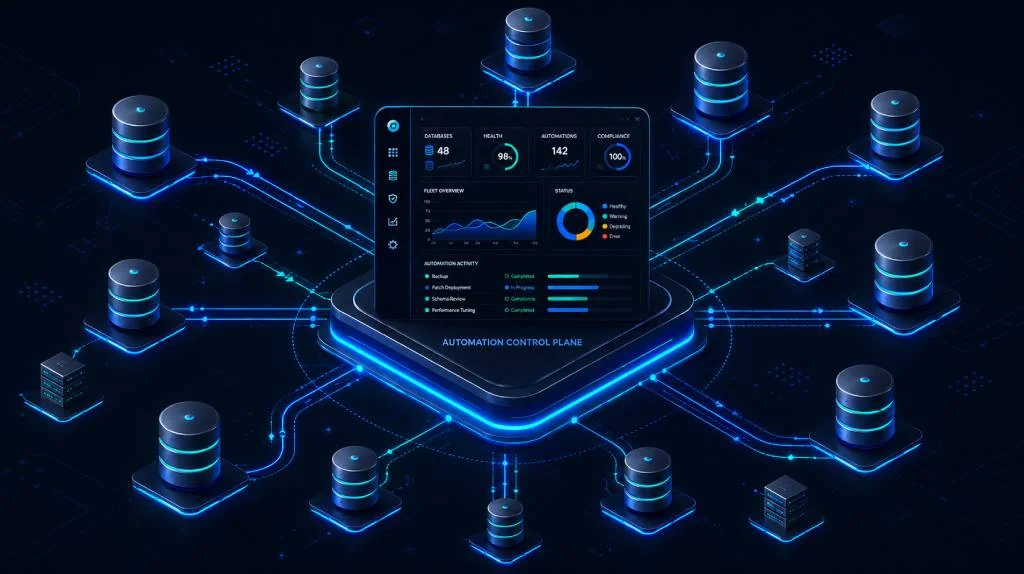
Discord’s Scylla Control Plane was built to turn risky manual procedures into structured workflows.
The main idea was not only to automate commands. The bigger idea was to create an extensible task framework. In that model, engineers define task inputs, implement task logic, and let the framework execute the workflow safely across supported clusters.
This is a major difference.
A script usually says, “Run these commands.”
A control plane says, “Understand the operation, validate the state, execute the next safe step, and recover when something goes wrong.”
That difference matters in distributed systems because cluster operations are rarely single-step tasks. Expanding a cluster, rolling an operating system upgrade, or creating a shadow cluster includes many smaller actions. Each action depends on the previous state of the system.
Discord’s SCP has already automated several important operations, including standing up new clusters, expanding clusters, rolling Ubuntu upgrades, rolling restarts after configuration changes, cycling binaries, applying Scylla YAML changes, sending SIGHUP, and running cleanups.
That is not a small improvement. It changes the day-to-day work of the infrastructure team.
Instead of manually guiding every step, engineers can trust a tested workflow. They still observe. They still review. But they are no longer the main orchestration engine.
Automated Database Scaling Is Really About Safer Workflows
A common mistake is to think database scaling means only increasing capacity.
In reality, scaling has two sides.
- The first side is technical capacity: more nodes, more CPU, more memory, more storage, more throughput.
- The second side is operational capacity: how safely and repeatedly the team can manage that infrastructure.
Discord’s story is mostly about the second side.
A database can support massive traffic, but if every upgrade creates fear, the system is not truly scalable from an operations point of view. If every cluster expansion requires a senior engineer to watch commands for hours, the team is still limited by human attention.
This is why automated database scaling needs guardrails.
A good database automation system should answer questions before running dangerous steps:
- Can this node be restarted safely?
- Is replication healthy?
- Is the target cluster in the expected state?
- Is a repair already running?
- Is this operation allowed during the current maintenance window?
- Can the workflow resume if one step fails?
ScyllaDB’s own documentation also shows why sequencing matters. For example, ScyllaDB warns that repair operations should not be mixed with maintenance operations such as add, remove, decommission, replace, rebuild, or schema changes because those combinations may lead to errors.
This is exactly the kind of rule that should live inside automation. A human may forget it during a stressful incident. A control plane should not.
The Role of Repair, Rebuild, and Cleanup in Enterprise Storage Sharding
When people hear the word sharding, they often think only about splitting data across machines. But enterprise storage sharding also creates operational responsibilities.
Data has to stay balanced. Replicas have to stay consistent. Old data that no longer belongs to a node may need to be cleaned. Failed or replaced nodes may need to rebuild data from other nodes.
ScyllaDB’s rebuild process streams data from other nodes in the cluster. The system first identifies the token ranges the local node is responsible for and then finds nodes that contain those same ranges.
Repair is another important operation. ScyllaDB describes repair as a background process that synchronizes data between nodes. For full cluster consistency, repair needs to be run properly across the relevant nodes or handled through ScyllaDB Manager, depending on the setup.
Cleanup also matters after ownership changes. ScyllaDB’s cluster cleanup removes data that nodes no longer own.
These operations are not glamorous, but they keep large storage systems healthy.
At petabyte-level or near-petabyte-level thinking, the cost of small operational mistakes becomes much higher. A missed repair, a badly timed rebuild, or an unsafe cleanup can create long-running incidents. Even when data is safe, the team may lose hours or days restoring confidence in the cluster.
This is why Discord’s move toward ScyllaDB cluster automation is a strong example for other teams.
The real win is not only faster provisioning. The real win is reducing uncertainty.
Shadow Clusters and Safer Database Releases
One of the most interesting parts of Discord’s article is the idea of standing up production-like clusters to validate new ScyllaDB releases before they touch production data.
This is a mature infrastructure pattern.
Instead of upgrading production and hoping the change behaves well, teams can create a shadow environment that receives real or realistic traffic patterns. This helps validate performance, replication behavior, operational safety, and application compatibility before the change reaches live users.
But shadow clusters are expensive to create manually.
Discord noted that spinning up a shadow cluster still required manual steps, and the team is working toward a single workflow that can handle the full lifecycle, including provision, configure, validate, and tear down.
This is where automation becomes more than convenience.
A shadow cluster can improve release safety only if the team can create it often enough. If it takes too much manual effort, engineers will avoid it unless the change is very large. If it becomes easy and repeatable, it can become part of the normal release process.
That is a practical lesson for any company running important distributed database infrastructure.
Do not only automate production recovery. Automate the safe testing path before production.
Why Manual Database Scripts Stop Working at Scale
There is nothing wrong with scripts in the beginning. Every serious platform has some internal scripts. The problem starts when scripts become the only layer of operational safety.
Scripts usually lack context.
They may not know if the cluster is healthy. They may not know if a node is already in a risky state. They may not understand if another operation is running. They may not provide a clean resume path after failure.
- This creates what I call “operator-driven reliability.”
- The system is reliable because the operator is careful.
- At small scale, this can work. At Discord scale, it becomes fragile.
- A better model is “workflow-driven reliability.”
The process itself becomes safer. The automation checks the current state. It prevents unsafe ordering. It gives engineers a clear view of progress. It fails loudly when assumptions are wrong.
That is the direction Discord took with SCP.
InfoQ also covered Discord’s work and described SCP as an internal orchestration framework that helps automate operations such as rolling upgrades, cluster expansion, shadow cluster provisioning, and node recovery across hundreds of database nodes.
This is the kind of infrastructure maturity that most growing engineering teams eventually need.
Lessons for Teams Building Distributed Database Infrastructure
Discord’s automated database scaling work gives several practical lessons.
The first lesson is to automate the workflow, not only the command.
A command can restart a node. A workflow knows whether that node should be restarted right now.
The second lesson is to make failures recoverable.
In large infrastructure operations, failure is normal. A node may be slow. A network call may fail. A validation step may not pass. The automation should help the team continue safely instead of starting from zero.
The third lesson is to reduce hidden knowledge.
If only two senior engineers know how to expand a cluster safely, the process is not scalable. The knowledge should move into tested workflows, documented steps, and system checks.
The fourth lesson is to treat database operations like software engineering.
That means modular design, reusable tasks, version control, testing, review, and observability. Infrastructure automation should not be a folder of emergency scripts that nobody wants to touch.
The fifth lesson is to invest before the team is overloaded.
Discord’s Persistence Infrastructure team is small compared to the scale of systems it manages. The team operates many clusters and hundreds of database nodes. Without automation, the work would keep growing faster than the team.
This is a common problem in engineering organizations. Headcount does not scale at the same speed as traffic. Good automation helps close that gap.
What This Means for Backend Engineers
For backend engineers, this case study is useful because it shows the difference between writing scalable application code and operating scalable systems.
A backend service may be well designed, but it still depends on storage. If the database layer is hard to operate, the whole platform becomes harder to evolve.
This is especially true for systems with high write volume, large datasets, and low-latency user expectations.
A real-time chat app, payment system, analytics platform, gaming backend, IoT ingestion pipeline, or notification system can all face similar pressure. The data model may be different, but the scaling pattern is familiar.
At some point, teams need to answer:
- How do we add capacity safely?
- How do we test database upgrades?
- How do we recover failed nodes?
- How do we rebalance data?
- How do we know the cluster is healthy before and after the change?
- How do we avoid depending on one expert’s memory?
- These questions are part of serious backend engineering.
Automated Database Scaling and the Future of Infrastructure Teams
The larger trend is clear. Infrastructure teams are moving from manual operation to internal platforms.
Kubernetes did this for container orchestration. CI/CD did this for software delivery. Observability platforms did this for monitoring and debugging. Now, more teams are building internal control planes for databases and stateful infrastructure.
This does not remove engineers from the process. It changes their role.
Engineers stop repeating risky steps manually and start designing safer systems. They define workflows. They build validations. They improve rollback and recovery paths. They turn one-off operational knowledge into reusable platform capability.
That is the future of automated database scaling.
For many teams, the first version does not need to be as advanced as Discord’s SCP. A good start could be:
- A standard checklist for cluster expansion
- Pre-check scripts that validate health before changes
- A single place to track operation state
- Safer wrappers around dangerous commands
- Automated post-change verification
- Clear runbooks for repair, rebuild, and cleanup
- Gradual movement from scripts to workflow orchestration
The important part is to avoid pretending that manual work will scale forever.
It will not.
Where AI Could Fit Into ScyllaDB Cluster Automation
This is not the main focus of Discord’s article, but it is worth thinking about.
AI will not replace database control planes. For critical infrastructure, deterministic workflows and strong validation are still required. But AI can support the human side of operations.
For example, AI agents could help summarize cluster health, explain failed workflow steps, generate safer runbook drafts, detect unusual operational patterns, or help engineers compare previous incidents with the current state.
However, the execution layer should remain controlled. In enterprise storage sharding, an AI system should not freely run destructive commands without strict guardrails.
The better model is AI-assisted operations, not AI-random operations.
For example:
- AI explains what failed.
- The control plane decides what is allowed.
- Engineers approve sensitive actions.
- Logs and metrics confirm the result.
That combination can make infrastructure teams faster without making the platform unsafe.
Final Thoughts
Discord’s ScyllaDB automation rebuild is a strong reminder that database scaling is not only a storage problem. It is an operations problem.
A distributed database can handle huge traffic, but the team still needs safe ways to expand clusters, rebuild nodes, run repairs, validate releases, and clean up data ownership changes. Without automation, those tasks become slow, risky, and dependent on a few experienced engineers.
Discord’s Scylla Control Plane shows a better path. Move from fragile scripts to structured workflows. Make operations recoverable. Build precondition checks. Reduce hidden knowledge. Treat infrastructure automation like a real software product.
That is what automated database scaling looks like in practice.
For engineering teams building high-throughput database systems, this is the real takeaway: scaling is not only about making the database bigger. It is about making the operational model strong enough to support that size.