
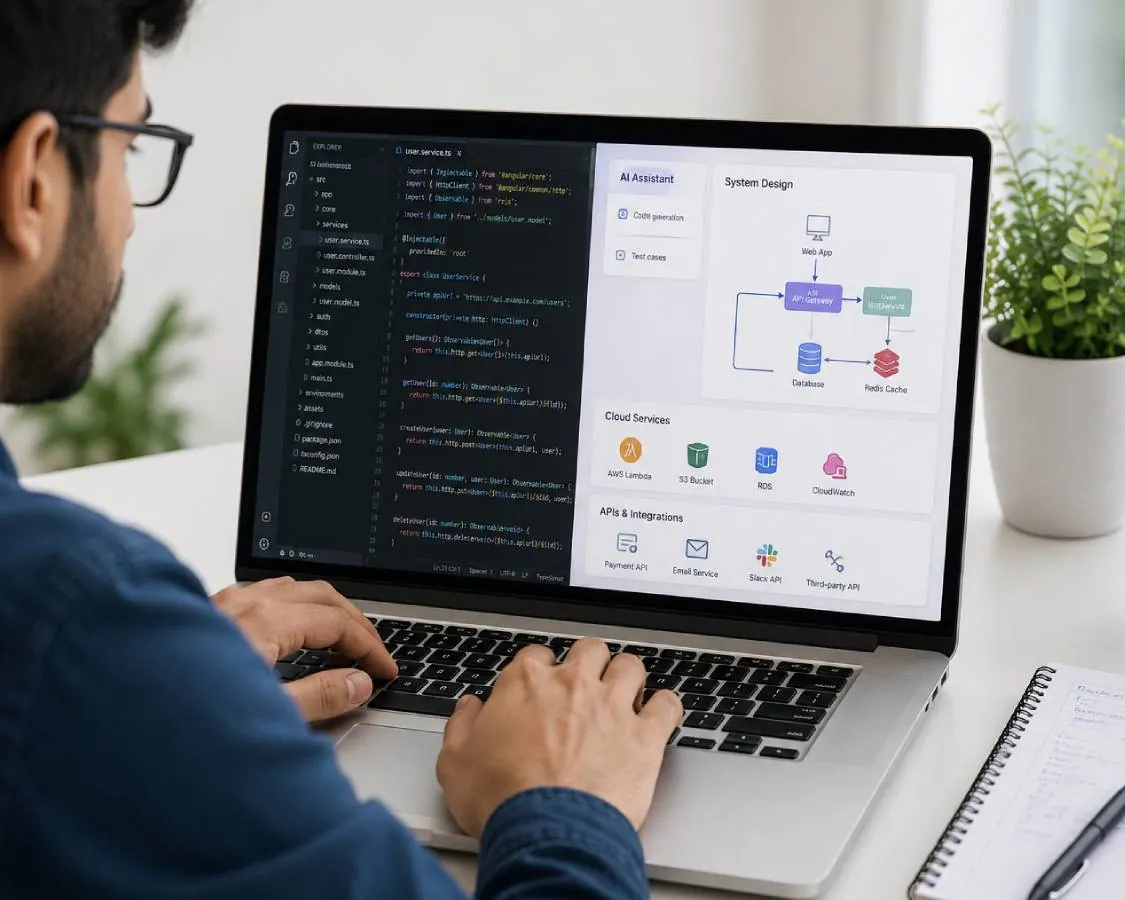

Artificial intelligence is changing Indian IT faster than most technology shifts I have seen during my career.
But I do not think the right question is, “Will AI replace software engineers?”
The more useful question is, “What kind of software engineer will companies still need when AI can write a large part of the code?”
That difference matters.
I have spent years working in frontend development, building applications, reviewing code, managing engineers, discussing architecture, fixing production problems, and working directly with product and client teams. Over the last couple of years, I have also been testing AI coding tools inside actual development workflows.
My experience so far has changed how I look at the AI impact on Indian IT.
AI is absolutely reducing the amount of manual work required to build software. Tasks that once took hours can sometimes be completed in minutes. Boilerplate code, unit tests, documentation, refactoring suggestions, API integrations, debugging ideas, and even complete UI components can now be generated surprisingly quickly.
But that does not mean engineering is disappearing.
It means the value of engineering is moving somewhere else.
And Indian software engineers need to move with it.
AI Impact on Indian IT Is Already Visible
This is no longer a future prediction.
The shift has already started.
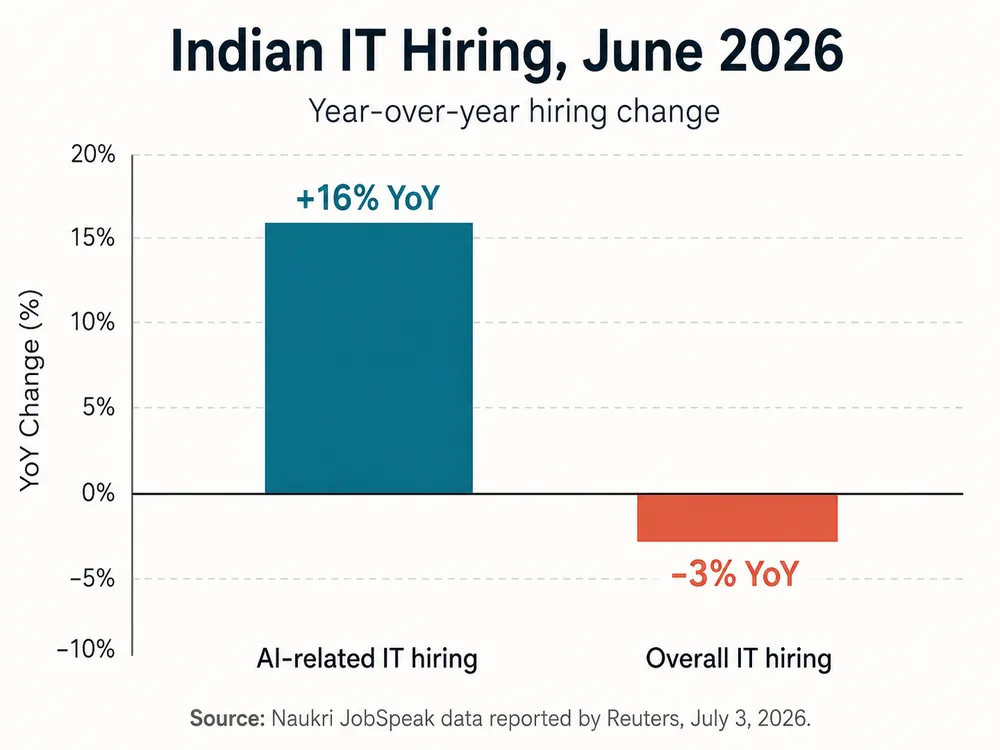
Recent hiring data provides a useful example. According to Reuters, citing Naukri JobSpeak data, AI-related hiring in India’s IT sector increased 16% year over year in June 2026, while overall IT recruitment declined 3%. The report says the data was drawn from job postings across more than 150,000 companies.
I find the contrast between those two numbers more important than either number alone. Companies are not simply moving away from technology hiring. They appear to be becoming more selective about the technical skills they are willing to hire for.
India’s technology industry itself is also changing how it creates value. The traditional Indian IT services model has relied heavily on large engineering teams, billable hours, outsourcing, maintenance contracts, and headcount growth.
AI challenges that model.
If ten engineers supported a workflow earlier and AI allows five engineers to manage the same output, customers will eventually question why they should continue paying for ten.
We are already seeing signs of this shift at the largest Indian technology companies. In June 2026, TCS Chairman N. Chandrasekaran said the company expects increased use of AI agents to reduce the number of people the industry needs to hire. He also said a future where TCS has as many AI agents as employees is not far away. Reuters reported that TCS’s net workforce had already fallen by more than 23,000 during the financial year ending March 2026.
That does not mean half a million employees are suddenly being replaced by AI agents. It does show how seriously one of India’s largest technology employers is thinking about the relationship between people, automation, productivity, and hiring.
This change will affect companies.
But it will also affect individual careers.
Coding Alone Is Becoming Less Valuable
For many years, being good at coding was enough to build a strong technology career.
You learned Java, JavaScript, React, Angular, Java, .NET, Python, Node.js, or another popular technology. You became faster at writing code, solved tickets, moved from junior developer to senior developer, and gradually increased your salary.
That path still exists.
But I do not think it will remain enough.
AI coding assistants are becoming extremely good at repetitive programming tasks.
Give an AI agent a clear requirement and enough project context, and it can already generate components, APIs, database queries, validation logic, test cases, documentation, and refactoring suggestions.
This is also why I believe developers should understand the ideas behind Vibe Coding Needs Context Engineering for Better Code.
The quality of AI-generated software depends heavily on the quality of the context, constraints, architecture, and engineering judgment surrounding it.
Writing the syntax is becoming easier.
Knowing what should be built, how it should fit into an existing system, and whether the generated solution is actually correct is becoming more important.
That is a very different engineering skill.
What I Have Seen While Using AI in Real Development Work
There is a big difference between watching someone build an AI-generated todo application on YouTube and using AI inside a real production codebase.
Production applications come with history.
There are existing APIs, business rules, tenant-specific behaviour, authentication flows, design systems, security requirements, legacy code, dependencies, deployment pipelines, performance concerns, accessibility requirements, analytics, tests, and dozens of decisions that are not written in the ticket.
This is where AI becomes interesting.
I regularly see AI generate code that looks completely correct at first glance.
Sometimes it is correct.
Sometimes it solves 80% of the problem.
And sometimes it confidently creates something that would introduce another problem somewhere else in the system.
That is why I do not currently treat AI like an engineer who should independently own production decisions.
I treat it more like an extremely fast technical collaborator.
I can ask it to explore approaches, generate repetitive code, explain unfamiliar areas, compare implementations, review logic, create tests, investigate errors, or help me understand a large code path.
But I still need to understand the system.
That part has not disappeared.
In many cases, it has become more important.
Interestingly, large developer surveys are showing the same tension.
The Stack Overflow Developer Survey 2025 found that 52% of developers said AI tools or AI agents had positively affected their productivity. At the same time, 46% actively distrusted the accuracy of AI tool output, compared with 33% who trusted it.
There is another number from the same survey that feels very familiar to anyone who has used AI for serious development. 66% of developers listed AI solutions being “almost right, but not quite” as a frustration, while 45% reported that debugging AI-generated code could be more time-consuming.
That combination makes sense to me.
AI can make you dramatically faster without automatically making every decision correct.
The engineer still needs to provide the judgment.
The Real Risk for Indian Software Engineers
I do not believe every software engineering job is about to disappear.
But I do think some types of work are much more exposed than others.
A developer whose primary value is converting a clearly written ticket into predictable code is competing more directly with automation.
Think about tasks such as creating standard CRUD screens, basic dashboards, straightforward API integrations, repetitive test cases, simple landing pages, documentation, routine migrations, or predictable code transformations.
AI is becoming good at these because the inputs and outputs are relatively clear.
The risk increases when an engineer understands only one small layer of the application.
For example, knowing how to build React components is valuable.
But knowing React plus APIs, browser behaviour, performance, accessibility, authentication, deployment, caching, monitoring, databases, product requirements, and system architecture makes you much harder to replace.
This is also why I still recommend strong fundamentals in my Complete Frontend Developer Roadmap for 2026.
Framework knowledge matters.
Engineering depth matters more.
There is some evidence that the impact may already be stronger at the entry level. Reuters reported in May 2026 that global capability centres in India were becoming more selective as AI changed the skills required for technology roles. Executives interviewed for the report also described routine entry-level work as an area increasingly affected by automation. You can read the Reuters report on how global firms are rethinking GCC hiring in India.
That does not prove that junior engineering jobs will disappear. It does suggest that the expectations attached to those jobs are changing.
The Future of Software Engineering Is Moving Toward Ownership
I believe the future of software engineering will reward people who can own larger parts of a problem.
Instead of receiving:
Build this component.Engineers will increasingly receive something closer to:
Users are abandoning this workflow. Find out why and improve it.That requires a completely different mindset.
You may need to inspect analytics, understand the business flow, talk to product managers, identify backend bottlenecks, examine frontend behaviour, question the current UX, use AI agents to explore the codebase, create a solution, test it, deploy it, monitor the result, and adjust again.
AI can assist throughout that process.
But someone still needs to connect everything.
That person becomes valuable.
System Architecture Skills Will Matter Much More
One area I would strongly recommend engineers invest in is architecture.
You do not need to become a principal architect overnight.
Start by understanding why your current application is designed the way it is.
Why was one service separated from another?

Why is Redis being used?

Why was PostgreSQL selected?

Why is authentication handled centrally?

What happens when traffic becomes ten times larger?

How does the application recover when one dependency fails?

Where should caching happen?

What belongs in the frontend and what belongs on the backend?

How do different tenants receive different functionality safely?Once you begin asking these questions, you stop thinking only about code.
You start thinking about systems.
AI can generate twenty possible implementations.
An experienced engineer needs to decide which implementation belongs inside the actual system.
That difference will become increasingly valuable.
AI-Native Does Not Mean Prompt Engineering
There is another mistake I see people making.
They assume learning AI means learning how to write better prompts.
Prompting is useful.
But it is not enough.
Using ChatGPT every day does not automatically make someone an AI engineer.
Knowing how to ask Cursor or another coding assistant to generate a component does not automatically make someone AI-native.
You need to understand how these systems work inside real applications.
Learn APIs.

Learn model limitations.

Understand context windows.

Understand embeddings and retrieval.

Experiment with agents.

Understand tool calling.

Learn how AI workflows are evaluated.

Understand security and privacy.

Learn where human approval should remain in the loop.

And most importantly, build something real.If you are starting from scratch, my AI for Developers: Complete Beginner Guide for Modern Coding is a good place to build that foundation before jumping directly into agents and complex AI architecture.
Move From AI User to AI Builder
This may be one of the biggest opportunities for Indian engineers.
Almost everyone is becoming an AI user.
Far fewer people know how to build useful AI-powered products.
A recent upGrad survey gives us a useful indication of this gap. According to an Economic Times report on upGrad’s Skill Shift study, 94% of the 2,075 Indian learners surveyed said they use AI, but only 26% had connected AI to another tool or used an API, and only 20% had built an AI-powered automation, agent, or application.
The survey represents upGrad learners rather than the entire Indian workforce, so I would not treat 94% as a national adoption number. But the difference between using AI and building with AI is still worth paying attention to.
That gap is an opportunity.
Instead of only asking AI to write your code, learn how to put AI inside your software.
- Build an internal support assistant.
- Create an intelligent document-processing workflow.
- Add semantic search to an application.
- Build an AI-powered reporting system.
- Create an agent that interacts with your internal APIs.
- Experiment with MCP.
- Create automated code-review workflows.
- Connect models with business data safely.
- Once you start building these systems, you understand AI very differently.
- You begin seeing both its power and its limitations.
Indian Tech Industry Trends Are Favouring Specialised Skills
There is another reason I would not panic about AI.
Demand is not disappearing everywhere.
It is shifting.
A Deloitte and NASSCOM analysis of India’s AI talent market projected that demand for AI talent in India could increase from approximately 600,000 to 650,000 professionals to more than 1.25 million between 2022 and 2027.
That does not mean 1.25 million traditional software engineering jobs will simply become AI jobs.
What it shows is that businesses expect a much larger requirement for people with AI-related capabilities.
The broader skill trend points in the same direction.
The World Economic Forum’s Future of Jobs Report 2025 identifies AI and big data as the fastest-growing skills, followed closely by networks and cybersecurity and technological literacy for the period leading to 2030.
Interestingly, the report does not suggest technical skills are all that matter. Creative thinking, resilience, flexibility, curiosity, leadership, and lifelong learning are also expected to remain important.
I think that combination matters for software engineers.
Knowing AI is useful.
Knowing AI plus systems, business problems, communication, architecture, and engineering judgment is much more powerful.
So when we discuss Indian tech industry trends, we should avoid thinking only in terms of job destruction.
Some roles will shrink.
Some workflows will need fewer people.
Some junior tasks will certainly become automated.
But entirely new engineering work is also appearing.
The challenge is that the new work may not require exactly the same skills as the old work.
Tech Career Upskilling Should Be Practical
If I were a software engineer worried about my career today, I would not spend the next six months collecting AI certificates.
I would build.
- Take the application you already work on and understand one layer deeper.
- If you are a frontend engineer, learn the backend.
- If you are a backend engineer, understand infrastructure.
- If you work mainly with APIs, learn system design.
- If you already understand full-stack development, learn cloud architecture.
- If you understand cloud architecture, explore AI architecture.
- Use AI in all of these areas while learning.
- This creates an interesting advantage.
AI actually makes tech career upskilling easier because you now have a technical assistant available whenever you want to explore something unfamiliar.
- Ask it why something works.
- Ask for alternative architectures.
- Ask it to challenge your implementation.
- Ask it to explain unfamiliar infrastructure.
- Ask it to generate a small proof of concept.
- Then verify everything yourself.
- That last part matters.
Do Not Stop Learning Fundamentals
I sometimes see developers saying that learning fundamentals no longer matters because AI can generate the implementation.
I think the opposite is true.
When calculators became common, understanding mathematics did not become useless.
When Stack Overflow appeared, understanding programming did not become useless.
And now that AI can generate code, understanding software engineering is not becoming useless.
The abstraction level is simply moving upward.
You may write less code manually.
But you will review more generated code.
You may remember fewer APIs.
But you will make more decisions about how APIs should interact.
You may spend less time fixing syntax errors.
But you may spend more time investigating architectural, security, reliability, and product problems.
The less code you personally write, the more important your ability to recognise bad code becomes.
The Stack Overflow survey data mentioned earlier supports why verification matters. When 46% of surveyed developers distrust AI output accuracy, blindly accepting generated code is clearly not a sensible engineering strategy.
AI can produce the first draft.
Engineering knowledge decides whether that draft belongs in production.
IT Workforce Automation Will Affect Junior Engineers First
One area where I do have concerns is entry-level hiring.
- Junior engineers traditionally learned by doing smaller tasks.
- Fix this UI bug.
- Create this API.
- Write these tests.
- Update this component.
Those are exactly the kinds of tasks AI can often handle quickly.
And there is emerging data worth watching.
An August 2026 report covering Nomura’s analysis found that India had recorded 83,100 AI-related jobs created compared with 31,921 AI-related layoffs and attrition cases in the dataset it studied. More importantly for junior developers, the same analysis cited an ICRIER survey of 651 Indian IT firms in which 55% reported a decline in entry-level hiring, compared with 25% for mid-level roles and 14% for senior roles. You can read the Economic Times coverage of Nomura’s analysis here.
I would be careful about interpreting those numbers as proof that AI alone is responsible for every hiring decline. Hiring is affected by client spending, economic conditions, automation, business restructuring, and many other factors.
But the direction is important enough for junior engineers to notice.
It creates a difficult question for the industry.
If AI performs much of the junior work, how do junior engineers gain enough experience to eventually become senior engineers?
Companies will need to rethink mentorship.
And juniors will need to accelerate their learning.
The answer cannot be avoiding AI.
Someone learning software development without AI in 2026 may eventually be competing against another junior engineer who can use AI effectively while still understanding the fundamentals.
The better approach is learning both.
- Write code yourself.
- Use AI.
- Review what it generates.
- Break things.
- Debug them.
- Build complete projects.
- Deploy them.
- Understand why they fail.
That experience develops engineering judgment.
My Career Rule for the AI Era
If I had to reduce everything to one rule, it would be this:
- Do not compete with AI at the things AI does best.
- Compete where humans still create the most value.
- Understanding unclear requirements.
- Making trade-offs.
- Communicating with stakeholders.
- Connecting technical decisions with business outcomes.
- Designing reliable systems.
- Recognising risk.
- Understanding users.
- Leading teams.
- Making architecture decisions.
- Taking responsibility when something breaks.
AI can assist with all of these.
But assistance is different from ownership.
The engineers who learn to combine both will have an advantage.
The AI Impact on Indian IT Is a Career Reset, Not the End
There is no point pretending nothing is changing. The AI impact on Indian IT will be structural. Traditional outsourcing models will evolve, teams may become smaller, expectations from individual engineers will rise, and routine programming will increasingly be automated. Some roles may disappear or change significantly.
But I do not see software engineering disappearing. I see its definition changing.
The engineer of the next decade may write less code manually but understand far more about the complete system. They will know how to work with AI agents, understand architecture, and have enough knowledge of frontend, backend, cloud, security, data, and product thinking to connect different parts of a problem.
More importantly, they will use AI as leverage rather than treating it as competition.
I have already changed the way I work because of this. I use AI heavily, but I am also deliberately spending more time understanding architecture, context, systems, engineering decisions, and how AI can operate inside real software workflows. That combination feels much more valuable to me than simply becoming faster at writing code.
For Indian software engineers wondering what to do next, my suggestion is simple: keep coding, but stop defining your career only by your ability to code.
That is where the real pivot begins.